
New Publication in Applied Surface Science on AZO Thin Films for Hydrogen Sensing Applications
We are pleased to announce that our latest research article, “Effect of oxygen partial pressure on structural, electrical and hydrogen sensing properties of AZO films”, has been published in the journal Applied Surface Science.
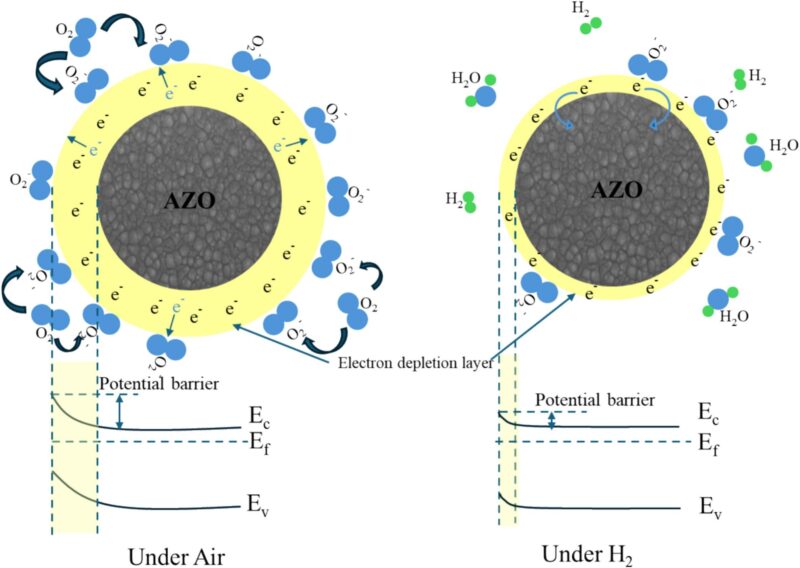
The study explores how oxygen partial pressure during DC magnetron sputtering affects the structural, optical, electrical, and hydrogen sensing properties of aluminum-doped zinc oxide (AZO) thin films. The findings provide valuable insights into optimizing transparent conductive oxides for optoelectronic applications and hydrogen sensing technologies.
The research was carried out by Malihe Ghaffari, Kamalan Mosas, Amirhossein Pakseresht, Necmettin Kilinc, Jose J. Velazquez, Lothar Wondraczek, Dušan Galusek, and Orhan Sisman.
Research Highlights
- AZO thin films were deposited using DC magnetron sputtering with different O₂:Ar gas flow ratios.
- Increasing oxygen partial pressure reduced film thickness and crystallite size while increasing microstrain and dislocation density.
- Optical band gap values decreased from 3.60 eV to 3.33 eV with higher oxygen incorporation.
- Electrical conductivity showed a strong dependence on oxygen partial pressure.
- Hydrogen sensing performance was evaluated at 100 °C and 150 °C for hydrogen concentrations ranging from 250 to 10,000 ppm.
The results contribute to a deeper understanding of how sputtering conditions influence AZO thin films and support the development of advanced materials for optoelectronics and hydrogen sensing applications.
Read the full article here:
Applied Surface Science article