
BRAHMS: A new simulation tool for nonlinear optical processes
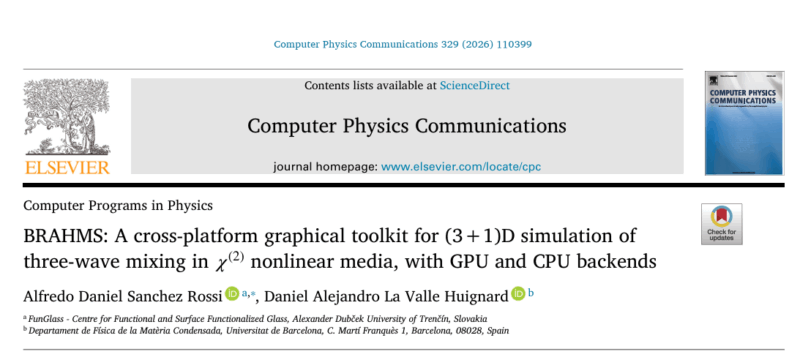
We are pleased to share that Dr. Alfredo Sanchez Rossi from the VILA Department at FunGlass has co-authored a new article presenting BRAHMS, a software tool developed for the simulation of second-order interactions in nonlinear optical materials.
The work, carried out in collaboration with Daniel Alejandro La Valle Huignard from the University of Barcelona, has been published in Computer Physics Communications.
BRAHMS is designed to simulate three-wave mixing processes, in which different light waves interact inside a nonlinear optical material. Such processes are important in applications including second-harmonic generation, sum-frequency generation, and optical parametric generation, which are widely used in nonlinear optics and laser technologies.
What makes BRAHMS particularly interesting is its ability to simulate these processes in three spatial dimensions while also taking the time evolution of the light pulses into account. This makes it possible to model the propagation of focused and pulsed laser beams through nonlinear materials in much greater detail than simplified approaches. Strictly speaking, it performs (3+1)D simulations in nonlinear interactions.
BRAHMS offers both CPU and GPU backends, with user interface for Windows and Linux, meaning that simulations can be set up and analysed without programming experience.
For FunGlass, the work highlights the growing role of computational methods in materials research, complementing experimental research with advanced simulations that can help researchers better understand and design optical processes in nonlinear materials.
Read the article: “BRAHMS: A cross-platform graphical toolkit for (3+1)D simulation of three-wave mixing in χ(2) nonlinear media, with GPU and CPU backends“
Journal: Computer Physics Communications
Authors: Alfredo Daniel Sanchez Rossi and Daniel Alejandro La Valle Huignard