
Advancing Green Hydrogen with Noble-Metal-Free Materials
Researchers from the Centre for Functional and Surface Functionalized Glass (FunGlass) at Alexander Dubček University of Trenčín, the Otto Schott Institute of Materials Research (OSIM) at Friedrich Schiller University Jena, Germany, and the Universidad de La Laguna, Spain, have contributed to a new study exploring materials for photocatalytic hydrogen production.
The research paper, “Noble metal-free zeolitic imidazolate framework-based composite for photocatalytic production of green hydrogen,” was published in OAE Microstructures in August 2026 (Q1, Impact Factor 8.5):
DOI: 10.20517/microstructures.2026.58
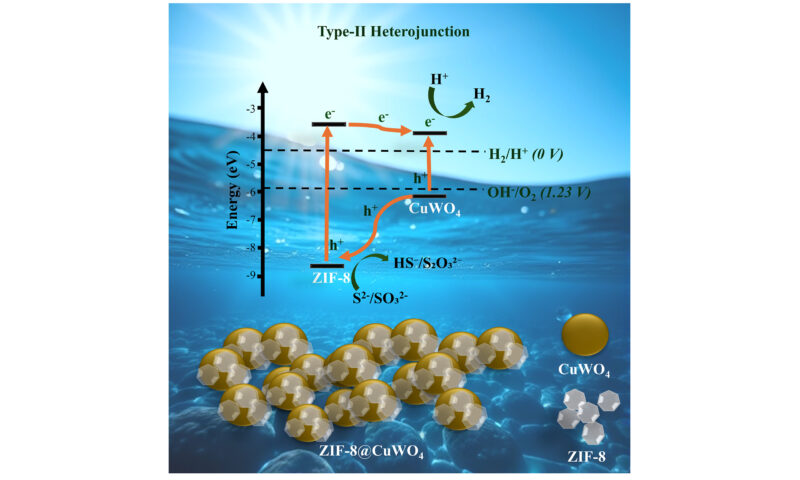
The study investigates a ZIF-8@CuWO₄ composite as a noble-metal-free photocatalyst for hydrogen production. The results indicate that combining ZIF-8 with CuWO₄ can enhance photocatalytic hydrogen-production performance compared with the individual materials investigated.
ABSTRACT: Photocatalytic water splitting could become a major pillar in addressing future demands for carbon-free energy supply. To develop noble-metal-free photocatalyst microstructures, a heterostructure photocatalytic system containing hexagonal Zeolitic Imidazolate Framework-8 (ZIF-8) and oxygen-deficient spherical CuWO4 nanoparticles was designed. In addition to preventing CuWO4 aggregation, ZIF-8 promotes the accessibility of active sites, interfacial charge transfer, and separation in the ZIF-8@CuWO4 composite. In this composite, UV-visible diffuse reflectance spectroscopy reveals substantial light absorption in the UV range, while photoluminescence spectroscopy indicates suppressed electron-hole recombination relative to pristine materials. The as-synthesised ZIF-8@CuWO4 exhibits a photocatalytic H2 evolution rate of 2,531 μmol g-1 h-1 under UV irradiation, higher than that of pristine ZIF-8 and CuWO4. The composite achieves a maximum H2 production rate of 79 μmol g-1 h-1 under visible light irradiation using Na2S/Na2SO3 (0.35/0.25 M) as the sacrificial hole scavenger. These results highlight that integrating ZIF-8 with CuWO4 could offer an effective option for improving photocatalytic green hydrogen production in CuWO4-based heterojunction systems.
The publication highlights the value of international collaboration, bringing together research groups from Slovakia, Germany, and Spain and combining complementary expertise in functional materials and photocatalysis.
The authors of the study are M. U. Iqbal, S. Rana, M. Zitnan, C. W. Ashling, M. Pérez-Ramos, I. Nadeem, M. González-Rodríguez, D. Galusek, P. Núñez, L. Wondraczek, and J. J. Velázquez.
The findings provide a basis for further research into noble-metal-free materials for photocatalytic hydrogen production. Further studies will be needed to evaluate their efficiency, stability, and practical applicability under real-world conditions.